Thursday, 21 April 2011

Heaping and Scattering? What could that possibly be?

When children follow a fascination in scattering they enjoy placing objects into a pile or scattering them into space for example they may tip all the bricks out onto the floor and/or scatter shredded paper or dry leaves.

One of the good things about children who scatter is that they like to heap. This can therefore be managed both ways. For example, scattering and then heaping is ideal because the child who wanted to throw the oats in this photo above also wanted to heap the oats thus encouraging him to tidy up after activities. Later in the blog I will gather some suggestions from staff around the nurseries and creches on how they manage our heapers and scatterers in the setting.

If a child is following a scattering schema offer them activities such as:
  • Shredded paper in troughs
  • Lolly pop sticks
  • Watering can with a rose
  • Dust pan and brush
  • Feeding the birds
  • Spray bottles
  • Sieves and colanders in sand and water
  • Whisks placed in liquid and taken out again whilst still spinning
  • Pasta, oats etc in flat trays or builders trays
  • Small Lego bricks/wooden blocks to scatter
  • Ball ponds

Allow children to scatter items into troughs, tuft trays, bowls; they can even throw wet sponges against a plastic sheet, use flours in flour shakers and blow and pop bubbles.

Sunday, 10 April 2011

Lets all TRANSPORT!

Transporting Water
 from one end of the garden to the other end.
Children transfer objects from one place to another often using trundle trolleys, buggies and buckets, or wheel barrows. Exploring transporting develops understanding of quantity and number.
Transporting a friend!


When transporting items these children will fill bags, prams, wheelbarrows (enveloping) and then transport them to another part of the nursery. They have been known to move furniture and even the whole of the role play area describing their play as 'moving house' or 'going on holiday'.

Do any parents recognize this schema at home?

The child who carries everything from one place to another and causes disarray in your home; moving furniture etc is likely to be following a transporting schema because nothing is ever left in its place.

But your child is learning! Transporting schema particularly involves mathematical and language development. When children collect objects or make heaps of things we can encourage them to estimate quantity and predict size and weight.

We can extend their language by making comments such as 'I can see you are...'
    These children used drain pipes and buckets
    to transport the water
  • pushing
  • pulling
  • going fast/slow
  • coming
  • going
  • carrying
  • collecting
  • forwards
  • backwards
  • weaving
  • making a pathway 


Friday, 11 March 2011

Connecting Schema

A connection schema is all about connecting things together. It does not necessarily need to link or interconnect either like a train track. Children following a connection schema may pat you on the hand or place a hand on your arm. These children just love to connect!

A child with a connection schema may:
  • tie your chair legs (or even your legs) together!
  • Love joining the carriages of trains together or train tracks - and then take them apart again.
  • Enjoy a variety of construction toys.
  • Like opening and closing doors.
  • Enjoy doing jigsaw puzzles.

<><><><><> 
A child following a connection schema enjoys a self-initiated game being connected together with friends


Monday, 7 March 2011

So, tell me about envelopment and enclosure.

Enclosure is all about 'insideness'. For example children may like to wrap things, cover things, fill empty space or enclose something or themselves.
This girl builds with blocks and encloses herself.


A child may begin to show evidence of having an enclosure schema from an early age. They may put toys inside the washing machine or small stones inside their pockets. As a parent this can be rather frustrating!

This girl uses a scarf and a necklace to enclose
her neck. Some children wear lots of bangles to enclose their arm.


Children who are following a enclosure schema are developing their understanding of capacity and volume. These concepts are important in the development of mathematical and scientific knowledge.

Envelopment Schema

A child who is fascinated with wrapping themselves up in materials and likes to cover their hands and body with paint are following an envelopment schema. These children enjoy exploring 'under' and 'insideness'. They like to fill bags, wrap up parcels, dress up, bury things - including their hands and feet - play inside tents and tunnels.

Once they have painted a picture they are more likely to cover it over completely or fold it up into a tiny piece then put it in their pocket.

Exploring an enveloping schema can help children to develop an understanding of space and size, volume and capacity. During their play envelopers develop ideas about estimating size and predicting - 'what fits inside this?' and 'How much paper will I need to wrap this box?'


This four year old decides to paint the window. It is completely covered with red paint.

Another child decided to paint the inside of a bowl. He then placed a box inside the painted bowl before painting the inside of the box.

Friday, 4 March 2011

What is a rotation schema?

Some children are fascinated by things that are circular or that spin and rotate. For example they are fixated on the washing machine when it spins fast or tumbles round. They like playing with water wheels, spinning tops, hoops and balls and rather than ride their bike they like to tip it upside down and spin the wheels.

Rotation is all about things that go round or have a round shape. This boy is rolling a tyre and will occasionally stop to rock the tyre to and fro in order to feel the roundness of the tyre.
Achild fascinated with rotation will:
  • like spinning round
  • love anything with wheels that turn
  • enjoy ring games and rotation dances
Children following a rotation schema may be interested in the movement aspect; 'When this goes round, this happens'. This is also an important schema in terms of the development of children's writing, as, in English,  many lower case letters involve an element of rotation. These children also enjoy repetitive stories and rhymes.

Trajectory Schema

What is a trajectory schema?

Trajectory is all about straight lines up and down or across.
Trajectory schema may have elements of vertical, horizontal and grid movements. 
A child that has a trajectory schema is interested in things, and themselves moving in straight lines;  up and down or across. It is a very common schema and one that young babies will often display;  explaining why they love to drop things from their highchairs.

This two year old builds a trajectory line with blocks

A child with a trajectory schema may
  • Always seem to be running around.
  • Likes throwing things.
  • Likes to play with running water.
  • Likes pushing or building things in a straight line.
Main behaviours associated with trajectory schema include:
  • Spending a long time in the bathroom playing with running water
  • Climbing onto and jumping off equipment  
Children placing cartons and crates in straight lines

  • Drawing or painting lines
  • Making lines of cars, bricks, animals etc
  • Making trails
  • Bouncing balls
  • Pouring water from jugs
  • Hose pipes and sprays
  • Dribble runny paint
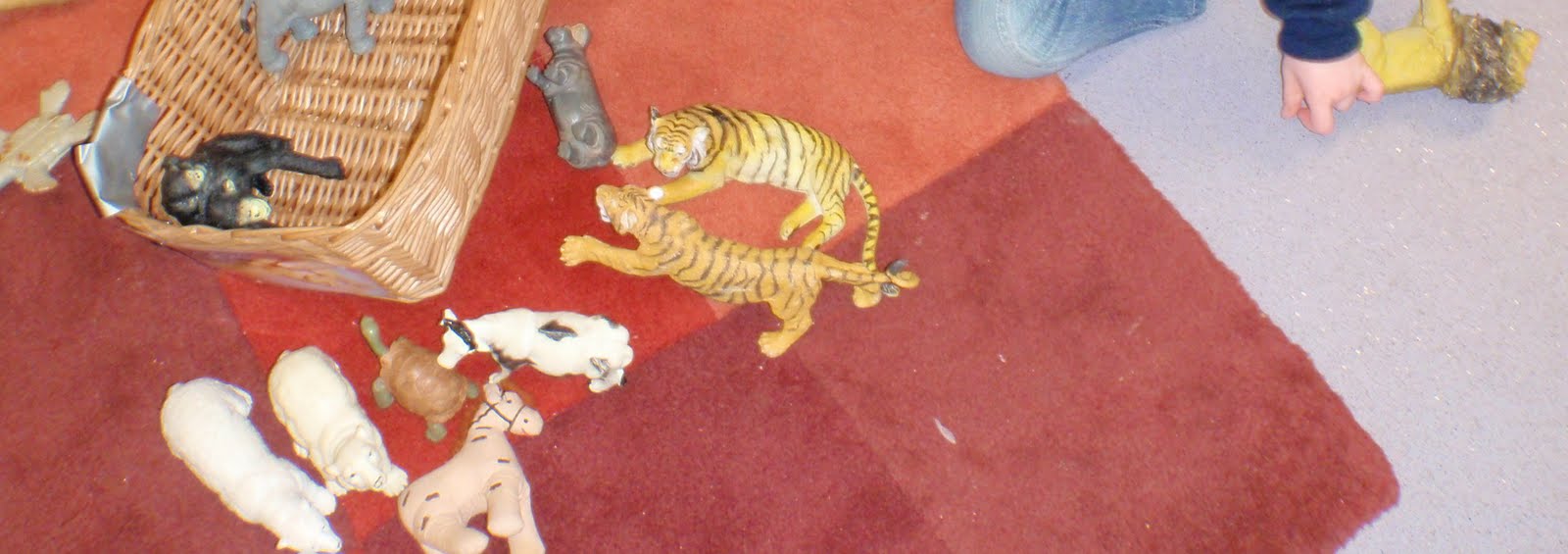
This two year old child has positioned animals in a straight line

Sunday, 20 February 2011

Okay, so what is a schema?

A schema is simply a pattern of behaviour. When you watch children's natural actions and investigations you notice that their behaviour is not random. There is a pattern to each indivdual child's behaviour. This pattern is called a 'schema'.

'Schemas are repeated behaviours that babies and young children use to explore and understand the world.' (Nutbrown 1994).

Some children have one very clear schema; others have a number of schemas called a cluster. In knowing which schema a child is following we can begin to make sense of what children are doing?

10 Common Schemas

  • Trajectory
  • Rotation
  • Connection
  • Transporting
  • Heaping and Scattering
  • On Top
  • Containment
  • Envelopment
  • Enclosure
  • Going Through A Boundary

Tuesday, 15 February 2011

Infected!

Like most people when first introduced to the concept of children following schemas; I was sceptic. My first thoughts being...'Really! Do children really do this stuff? I've never noticed those kinds of behaviours in any of the children attending our nurseries! Surely, it's just a coincidence. After all, these patterns of behaviour from our children are random? Right?!

Wrong!

Schemas are now recognised as an important part of children's growth and learning and there is even a place for it in the Early Years Foundation Stage (EYFS). However, it was the schema training that I attended recently that really inspired me and made me look at how we approached children's learning and development in our settings; It made me question:
  • What are we doing in terms of following children's real interests?
  • Why do we plan activities and new experiences the way we do?
  • Is our planning and assessment effective and personal to all our children?
  • How could we use the schema approach to improve upon what we do?
  • How could we make it work for us?
 My main intention is to enable practitioners to identify and understand what schemas are and how they can plan for and support children's learning and development through using this new knowledge of children's current schemas (interests). But before I can do that I have to infect my colleagues, as I was infected; hope that 70 plus staff  feel my own excitement about such a major change to TEYP and convince them to give me a chance to show that using schemas as an approach to understanding and planning for children's learning is the way for us to go.

The road is long!